Water leaks, ground subsidence raise concerns at Isfahan’s UNESCO-listed mosque

TEHRAN - Iranian authorities and heritage experts are racing to contain what they describe as a structural threat to parts of the UNESCO-registered Jameh Mosque of Isfahan, also known as the Atiq Mosque, after a limited ground subsidence, water leakage and rising moisture were detected around one of the world’s most important Islamic monuments.
Provincial crisis management officials on Tuesday said emergency measures are needed to prevent further damage to the more than 1,000-year-old mosque complex, warning that failures in surrounding water and sewage infrastructure could weaken sections of the historic structure, including areas near the famed Nezam al-Molk dome of the enormous mosque.
The warning follows reports of subsidence in passageways behind the Nezam al-Molk dome, visible cracks in parts of the western prayer hall, and the saturation of absorption wells and drainage channels with water after a burst pipe went unnoticed for weeks.
Mansour Shishehforoush, director of crisis management at the provincial governor-general’s office, said authorities had convened an emergency session to assess the situation and coordinate urgent interventions.
“Given that the situation may lead to a critical stage, we must act immediately,” Shishehforoush said on Tuesday on the sidelines of field visit to the site, according to IRNA. “Crisis management teams must be deployed without delay, and under the supervision of cultural heritage bases, emergency measures must be carried out to repair damaged pipes and infrastructure.”
He said defects in water and wastewater networks around the mosque, along with deteriorated paving in surrounding passageways, posed a direct risk to the historic fabric of the monument.
“This work must be done quickly and with the cooperation of all responsible bodies, including the municipality, the water and wastewater company, and the cultural heritage authorities,” Shishehforoush said.
“These issues must be followed moment by moment so that no future problem arises for the Jameh Mosque of Isfahan,” he said.
He also highlighted the importance of addressing absorption wells and inadequately drained channels around the mosque, saying their status must be carefully reviewed by experts from cultural heritage and water authorities.
“Given the historical and cultural importance of the Jameh Mosque, no delay in protective and corrective measures is acceptable,” he said. “All agencies must cooperate fully.”
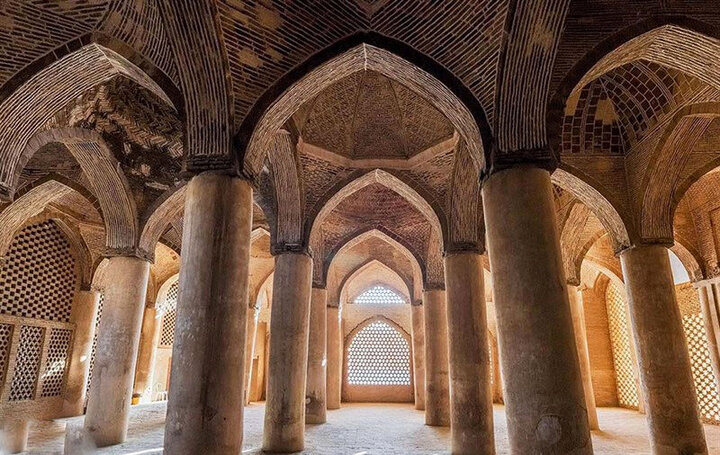
Moisture, subsidence and structural risk
Over the past couple of weeks, heritage activists and experts have reported subsidence in a passageway behind the Nezam al-Molk dome. Following follow-up by specialists from the World Heritage Base of the Atiq Jameh Mosque, field investigations were launched to identify the cause of moisture along the mosque’s southern wall, the sinking of the rear passage, and cracks that have appeared in recent months in the western prayer hall near the Nezam al-Molk dome.
As mentioned by IRNA, the inspections found that a water pipe had broken roughly a month earlier, filling all absorption wells in the area with water to a height of about four meters. The walls of moisture drainage channels were also found to be damaged or destroyed.
Experts at the site said that during the past month, parts of the ceilings in the western prayer hall near the Nezam al-Molk dome had developed cracks and showed signs of slippage, while the western entrance of the southern prayer hall had also subsided.
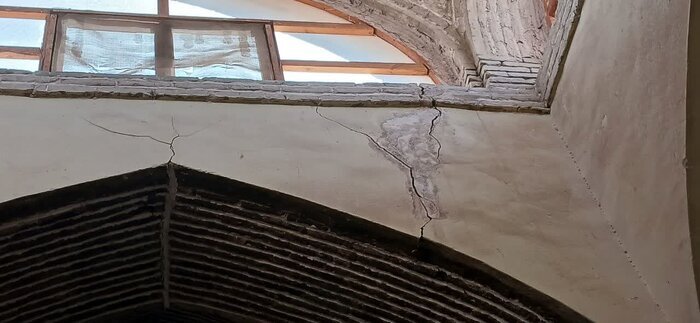
Experts warn of ‘silent’ danger
While officials have stressed that there is no evidence of imminent collapse, a number of Iranian experts in heritage conservation, archaeology and architecture have issued stark warnings about the long-term consequences of unchecked moisture and ground instability.
In interviews with Mehr news agency, four prominent specialists outlined what they described as a “creeping” threat to the Nezam al-Molk dome and surrounding structures.
Mohammad-Mehdi Kalantari, secretary of a national campaign to save Iran’s historic buildings, sites and urban fabrics, said the main danger lay not in a single burst pipe but in the volume of water released and the duration of its infiltration into the soil beneath the monument.
“Moisture becomes a serious threat when it penetrates the soil unnoticed and gradually reduces its load-bearing capacity,” Kalantari said. “The Nezam al-Molk dome is not a light structure. Its concentrated weight is transferred through its supports into the ground. If the soil beneath these supports becomes saturated and loses strength, the risk of gradual subsidence emerges.”
He warned that water can infiltrate soil layers for months or even years without visible surface signs, and that by the time dampness reaches the walls, “the crisis has often already begun.”
Kalantari said that even if the pipe rupture itself was relatively recent, it was impossible to rule out danger without detailed geotechnical studies assessing the depth of moisture penetration and soil conditions.
From his perspective, moisture is the trigger for a chain of gradual settlements that can ultimately lead to structural failure in heavy historic constructions such as the Nezam al-Molk dome.
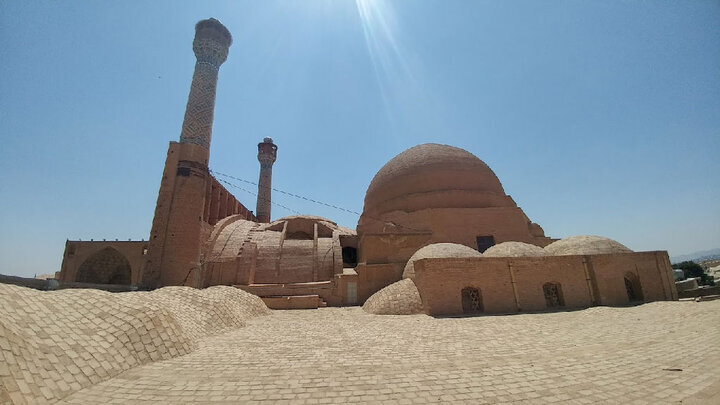
Vulnerability of brick architecture
Alireza Jafari-Zand, an archaeologist and heritage activist, said the Nezam al-Molk dome holds a unique place in architectural history as the first successful example of the transition from columned mosques to domed mosques in Iran.
“From a technical standpoint, it is an exceptional structure,” he said. “But no brick building, even the most robust, is immune to moisture.”
He noted that Seljuq architecture is renowned for its structural strength and foundations, yet its materials, which are mainly brick and mortar, are vulnerable to repeated wetting and drying cycles, which gradually reduce their strength.
“Moisture does not only damage surfaces,” Jafari-Zand said. “Over time, it weakens mortars, alters structural behavior and increases vulnerability to lateral forces.”
He also pointed to other concurrent pressures, including widespread land subsidence in Isfahan and the passage of metro tunnels near the mosque complex, arguing that these combined factors made continuous monitoring essential.
“In a monument of this global importance, even millimeter-scale cracks must be continuously measured and analyzed,” he said. “Ignoring small signs paves the way for major crises, including the potential collapse of the Nezam al-Molk dome.”
Combining factors heighten risk
Shahriar Nasekhian, head of the conservation department at Isfahan University of Art, said moisture alone would not usually cause the sudden collapse of a structure like the Nezam al-Molk dome in the short term, but warned of danger when combined with other factors.
“Traditional brick structures have always coexisted with some degree of moisture,” he said. “It becomes a threat when combined with subsidence, inappropriate loading around the monument, changes in passage levels and weak urban infrastructure.”
Nasekhian said the observed cracks did not necessarily indicate an immediate collapse, but clearly constituted warning signs requiring specialist investigation.
“For UNESCO-listed monuments such as the Atiq Jameh Mosque, round-the-clock monitoring is essential,” he said. “Even millimetric changes matter, and any negligence can have irreversible consequences.”
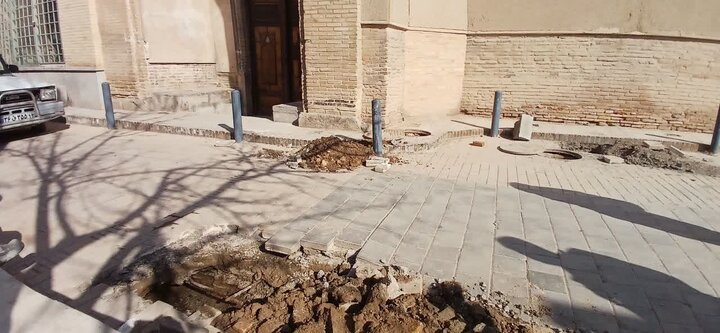
Soil behavior and structural equilibrium
Eskandar Mokhtari-Taleqani, a member of Iran’s high council for the supervision of cultural heritage conservation and restoration, said the issue extended far beyond a single incident of pipe failure.
“The core problem is the structural consequences of moisture for a building that has stood in complete equilibrium with its ground for more than a thousand years,” he said.
Mokhtari explained that domes transfer large loads to their supports, which then pass these forces directly into the ground. Any change in soil behavior beneath those supports, he said, has an immediate effect on the structure’s balance.
“Moisture is the main factor that alters soil behavior,” he said. “The danger becomes acute when this change is uneven. If part of the ground becomes saturated while another part remains dry, a behavioral discontinuity forms in the soil. From an engineering perspective, this is one of the most dangerous scenarios for historic buildings.”
He said that even the most technically advanced monuments of their time are not immune to such imbalances.
Asked whether moisture could ultimately cause the collapse of a dome as strong as Nezam al-Molk’s, Mokhtari said it was “entirely possible.”
“When part of the foundation loses equilibrium due to moisture, the building also loses its historical balance,” he said. “This is the start of a dangerous process, not a sudden event.”
A monument of global significance
The Jameh Mosque of Isfahan, located in the historic center of the city, is one of the oldest Friday (congregational) mosque in Iran and one of the most significant monuments of Islamic architecture worldwide. It represents more than 12 centuries of architectural evolution, encompassing styles and innovations from the Abbasid, Buyid, Seljuq, Ilkhanid, Muzaffarid, Timurid and Safavid periods.
Following major expansion under the Seljuqs, the mosque became the prototype for the four-iwan (Chahar Ayvan) layout that later spread widely across the Islamic world. It is renowned for its two extraordinary domes, including the Nezam al-Molk dome, one of the earliest double-shell ribbed domes in Islamic architecture, and the Taj al-Molk dome, celebrated for its refinement and proportional harmony.
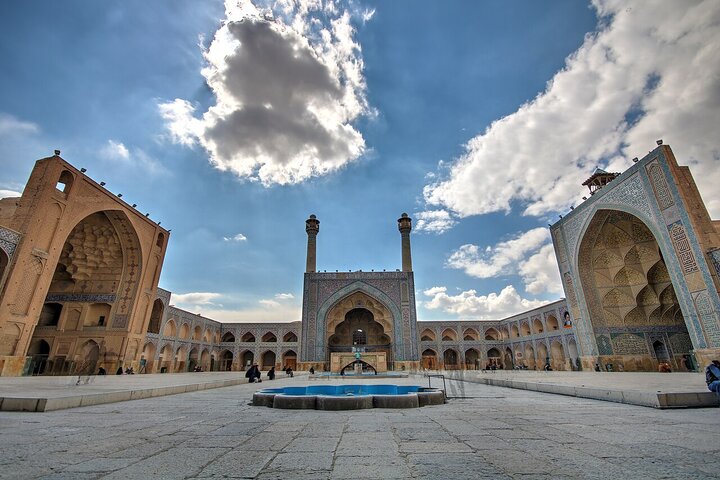
Built on the site of an earlier fire temple, the mosque’s origins date back to the second century of the Islamic calendar. Over centuries, successive dynasties added prayer halls, iwans, courtyards and decorative elements, turning the complex into what many scholars describe as a living museum of Iranian architecture.
AM
Leave a Comment